
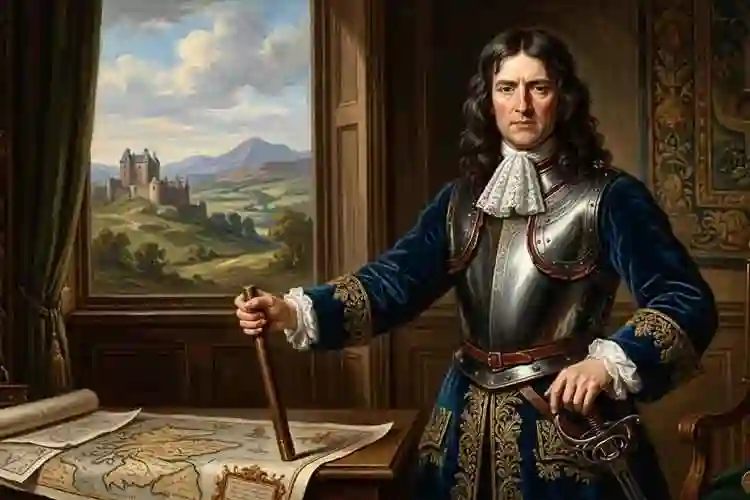
JJohn Graham of Claverhouse—or “Bonnie Dundee,” as his popular nickname states—remains one of Scotland’s most enigmatic and mythologized figures. A steadfast Royalist and devoted adherent to the exiled House of Stuart, Graham led the Jacobite forces in the Rising of 1689, meeting his end at the Battle of Killiecrankie on July 27th of that year.
To understand his deep connection to Tayside, one must look closely at his ties to Dundee itself. Claverhouse held the post of Constable of Dundee and spent considerable time residing at Dudhope Castle. His local ties also extended to nearby Claypotts Castle, making the local landscape an integral backdrop to his rise as a formidable military commander.
The Nightmare of Bonnie Dundee
Legend says that on the eve of Killiecrankie, Claverhouse was plagued by a terrifying nightmare. In his vision, he saw a bloodied body lying upon a bed, its head severely wounded. The ghost pointed a finger at him and cried out, “Remember Brown of Priesthill!”
John Brown was a committed Covenanter executed in 1685 for his faith—a death in which Claverhouse had famously played a direct role. According to the tale, the nightmare deeply unsettled Claverhouse, causing him to hesitate on the morning of the battle. Despite his forebodings, tactical pressure forced him to order the attack. As the Highland charge began to break the government lines, Claverhouse regained his composure and rode out to lead the cavalry.
The Death of Bonnie Dundee
His triumph was brief. Claverhouse was struck in the torso by musket shot—folklore long claiming it was a silver bullet—and died on the field at the age of 41. He was carried from the battlefield wrapped in tartan and buried at St Bride’s Kirk in Blair Atholl.
Today, visitors can explore the battleground preserved by the National Trust for Scotland, where local lore still claims that a ghostly red glow marks the Pass of Killiecrankie on the anniversary of his fall.
A Rally on the Law
Centuries later, the story of Bonnie Dundee continues to resonate across Angus and Tayside. On Saturday, 10th April 2004, members of Na Fir Dileas and the White Cockade Society gathered in Dundee to mark his memory with a ceremonial raising of the Jacobite Standard.
Assembling at Dudhope Castle, marchers in Highland dress escorted the banner up to the top of Dundee Law—the “Tap o’ the Law.” Historian David Ross addressed the gathering, emphasizing the pivotal role Dundee played in the opening chapter of the 1689 rising. It was on 13th April 1689 that Claverhouse famously raised the Royal Standard on Dundee Law, defying the Parliament in Edinburgh and effectively launching the first Jacobite campaign.
Author Andrew Murray-Scott also reflected on Claverhouse’s complex legacy during the event, reminding those present that while the wider Jacobite cause ultimately ended in defeat at Culloden in 1746, the local story of 1689 remains a compelling chapter in Dundee’s heritage.
When the Standard was unfurled near the Law’s monument, a piper struck up a traditional lament that echoed over the city below. The event served as a solemn modern tribute to a figure whose name remains firmly etched into the landscape of local history.
The Historical Legacy in Modern Dundee
Whether viewed as “Bluidy Clavers” by Covenanter sympathisers or as the heroic “Bonnie Dundee” by Jacobite loyalists, John Graham of Claverhouse left an indelible mark on the region. His former residence at Dudhope Castle stands today as a tangible reminder of the late 17th century, anchoring Dundee right at the centre of Scotland’s national story.
The Image is an artistic interpretation of Bonnie Dundee